

Choosing the wrong bag thickness can lead to breaks, spills, and damaged products. This costs you money and customer trust. But understanding thickness is simple and keeps your goods safe.
The right polybag thickness depends entirely on your product. For light items like apparel, 1.2-2.0 mil is enough. For general use, use 2.4-3.1 mil. For heavy items like hardware or bulk foods, you need 3.9 mil or more to prevent breaks and ensure safe delivery.
Choosing the right thickness seems like a small detail, but it has a huge impact on your business. A bag that is too thin can break, ruining your product and your customer's experience. A bag that is too thick, on the other hand, means you are overpaying for packaging you don't need. Getting this right saves you money and protects your brand's reputation. Let's break down exactly what thickness you need for different products, so you never have to worry about a broken bag again.
How Are Polybag Thicknesses Measured?
Confused by terms like "mil" and "microns"? This confusion can lead to ordering the wrong bags. Let us help you understand these simple but important terms.
Bag thickness is measured in mils or microns. One mil is one-thousandth of an inch. In China, we often use "si", where 10 si equals 0.1mm. Understanding these units helps you compare options and order correctly from any supplier in the world.

When you're sourcing packaging globally1, you will see different units for thickness. It's important to know what they mean so you can make an apples-to-apples comparison. In our factory, we work with all of them, but let me explain the most common ones.
First, there is the mil. This is a standard unit in the United States. One mil is not a millimeter. It is one-thousandth of an inch (0.001 inches). It's a tiny measurement, but in the world of plastic bags, it makes a big difference.
Second, you have the micron (μm). This is the metric unit, and it's used in most parts of the world. A micron is one-thousandth of a millimeter (0.001 mm).
Finally, in the Chinese packaging industry, you'll often hear the term "si". This is a very common informal unit here. It's simple: 10 si equals 0.1 mm. So, 1 si is equal to 10 microns.
Here is a simple table to help you convert between them:
| Common Name | Mil | Microns (μm) | Millimeters (mm) | China "si" |
|---|---|---|---|---|
| Light Duty | 1.2 mil | 30 μm | 0.03 mm | 3 si |
| Standard Duty | 2.0 mil | 50 μm | 0.05 mm | 5 si |
| Regular Duty | 3.0 mil | 76 μm | 0.076 mm | ~8 si |
| Heavy Duty | 4.0 mil | 101 μm | 0.101 mm | ~10 si |
| Extra Heavy | 6.0 mil | 152 μm | 0.152 mm | ~15 si |
Knowing these conversions is key. It ensures that when you order a 2.0 mil bag from a US supplier or a 5 si bag from us, you know you're getting the exact same product.
What Thickness Is Best For Lightweight Products?
Are you overspending on thick bags for your light items? Using the right thin bag saves money. But choosing one that is too thin can cause rips. Let's find the balance.
For lightweight items like t-shirts, documents, or small snacks, a thickness of 1.2 to 2.0 mil (around 3-5 si) is ideal. It provides enough protection for non-sharp items without adding unnecessary cost or weight to your shipping.
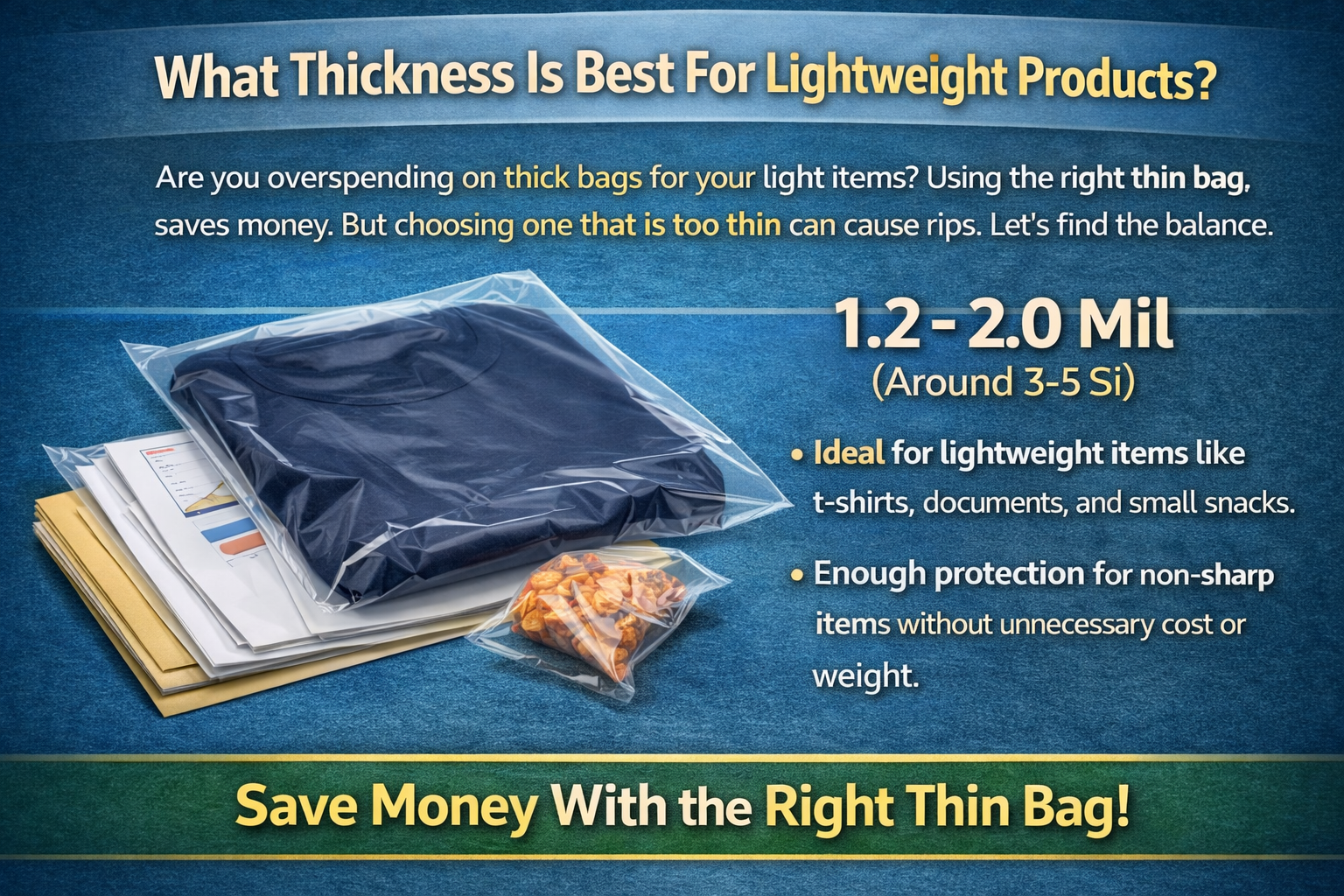
This category, which we call "ultra-thin," is perfect for many businesses, especially in e-commerce. These bags are typically between 1.2 mil and 2.0 mil (or 3 to 5 si). They are designed for products that don't have sharp edges and are not very heavy. The main benefit here is cost-effectiveness. You are not paying for plastic you do not need. This reduces your material costs and your shipping weight, which can lead to significant savings over time.
Common Uses for Lightweight Bags:
- Apparel: T-shirts, scarves, socks, and other small clothing items are perfect for these bags. Many of our clothing clients use self-adhesive bags of this thickness.
- Food: Think of bread bags or bags for small pastries. They keep the product fresh without needing heavy-duty strength.
- Documents & Stationery: Mailing papers or small booklets where you just need a layer of protection from moisture.
- Small Parts: Lightweight plastic components or accessories that are not sharp.
The key is to match the bag to the item. While these bags are strong enough for their intended purpose, they have low puncture resistance2. If your product has sharp corners, like a small box or a piece of jewelry, this thickness is not the right choice. You would need to step up to the next level to avoid tears during transit.
When Do You Need a Standard or Heavy-Duty Bag?
Worried your products are too heavy for a regular bag? A broken bag can ruin a customer's experience and your products. Let's ensure your goods are secure.
Use a standard 2.4 to 3.1 mil (6-8 si) bag for general-purpose use like groceries or multi-item orders. For heavy items like hardware or bulk foods, upgrade to a heavy-duty bag of 3.9 mil (10 si) or more to guarantee strength.
Once your product's weight or shape demands more durability, you move into the standard and heavy-duty categories. This is where most products fall.
Standard Thickness: The Versatile Workhorse
A standard thickness bag is typically between 2.4 to 3.1 mil (6-8 si). This is the most versatile and common range. It offers a great balance of cost, strength, and durability. These bags have better puncture resistance2 than the lightweight options and can handle more weight. We see them used for:
- Supermarket Shopping Bags: Strong enough to hold a variety of groceries.
- E-commerce Mailers: Perfect for shipping a hoodie, a pair of jeans, or multiple smaller items together.
- Retail Store Bags: Die-cut handle bags that customers use to carry their purchases home.
Heavy-Duty Thickness: For When It Really Matters
When you get to 3.9 mil (10 si) and above, you are in heavy-duty territory. These bags are for when strength is the number one priority. I remember a client who learned this lesson the hard way. He was packaging heavy metal hardware parts. He chose a 4 si bag to save on costs. The bags looked fine, but as soon as his team filled them, they split open. The parts were heavy and had some edges. We helped him switch to a 10 si (3.9 mil) bag, and the problem was solved immediately. It's a clear example of how a small detail like thickness can make or break your packaging.
Use heavy-duty bags for:
- Bulk Foods: Like 5kg bags of rice or pet food.
- Hardware: Nuts, bolts, and other dense metal parts.
- Industrial Components: Anything heavy, potentially with rough edges, that needs to stay contained.
What Are Ultra-Thick Bags Used For?
Do you need the absolute maximum protection for your products? Some items require industrial-strength packaging. Don't risk damage by using a standard bag for a specialized joUltra-thick bags, typically 5.5 mil (14 si) and above, are for specialized applications. This includes industrial parts packaging, high-strength waterproof bags3, and vacuum storage bags4 where durability and barrier properties are critical.
When you move beyond 5.5 mil (or about 14 si), you are entering the world of specialized, high-performance packaging. These ultra-thick bags are not for everyday items. They are engineered for specific, demanding tasks where failure is not an option. The thickness provides extreme puncture resistance2, tear strength, and often, enhanced barrier properties against air and moisture. At our factory, we produce these for clients with very specific needs.
Applications for Ultra-Thick Bags:
- Vacuum Storage Bags: If you've ever used a vacuum bag to shrink down clothes or bedding for storage, you've used an ultra-thick bag. The thickness is crucial to maintain the vacuum seal over time and resist being punctured by zippers or buttons.
- Industrial Packaging: For heavy, sharp, or abrasive industrial components5. Think about machine parts or construction materials that would tear through a normal bag instantly.
- High-Strength Waterproof Bags: Companies making gear for outdoor activities like kayaking or camping need bags that are not only waterproof but also tough enough to be scraped against rocks and branches.
- Anti-Static Bags: For sensitive electronic components, a thick, durable bag provides physical protection in addition to shielding from electrostatic discharge.
These bags often use advanced materials, such as multi-layer laminated films, to achieve their performance. The thickness is a key part of that formula, ensuring the bag can withstand a high degree of stress. While they are more expensive, they provide a level of security that is essential for these high-value or demanding applications.
Conclusion
Choosing the right bag thickness protects your products, saves money, and keeps customers happy. Match the mil or 'si' to your product's needs for perfect packaging every time.
Discover the importance of understanding different measurement units in global sourcing. ↩
Learn why puncture resistance is crucial for ensuring product safety during transit. ↩
Explore the applications of waterproof bags in outdoor and industrial settings. ↩
Understand the importance of thickness in vacuum storage for maintaining seals. ↩
Learn about the specific requirements for packaging industrial parts safely. ↩